
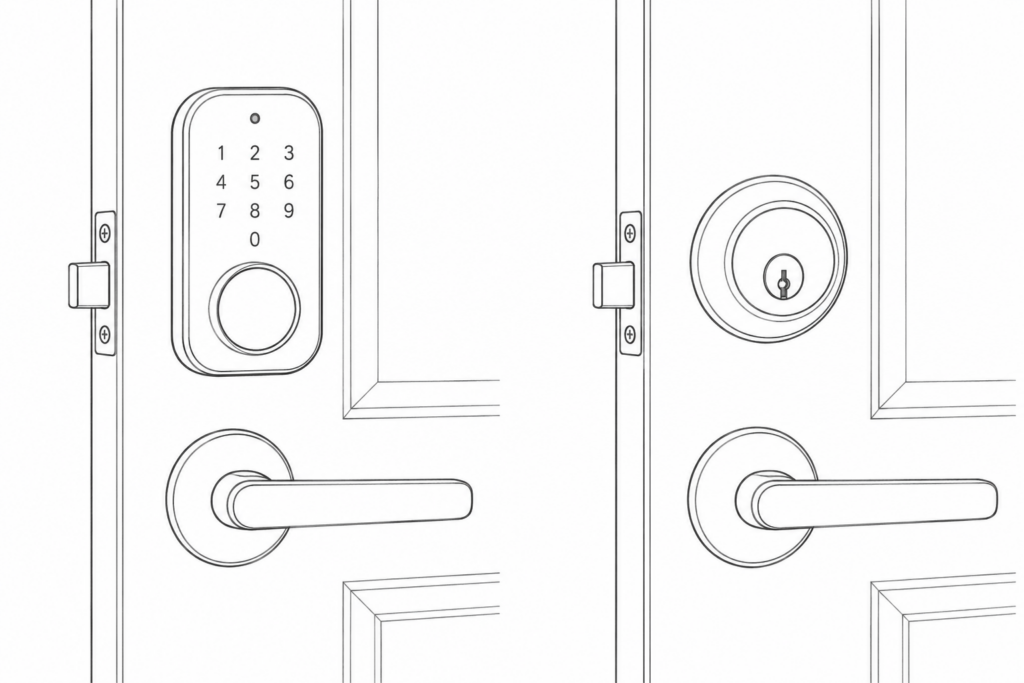
It’s one of the most common questions I get asked as a locksmith: should you upgrade to a smart lock, or stick with a traditional deadbolt? The honest answer is — it depends on what “safer” means to you. Here’s how they actually compare, based on what I’ve seen in the field over the years.
Physical Security: Mostly a Tie
Strip away the technology, and most smart locks use the same core mechanical components as a traditional deadbolt — a bolt, a cylinder, and pins or a similar locking mechanism. A quality smart lock (think Schlage or Yale’s higher-end models) uses ANSI Grade 1 or 2 hardware, the same standard you’d look for in a traditional deadbolt.
The catch: cheaper smart locks sometimes cut corners on the mechanical side to fund the electronics, resulting in a lock that’s technologically impressive but physically weaker than a $30 traditional deadbolt. Don’t assume “smart” automatically means “stronger” — check the ANSI grade either way.
Where Smart Locks Introduce New Risks
Smart locks add attack surfaces a traditional deadbolt simply doesn’t have:
- Wireless vulnerabilities — Bluetooth or Wi-Fi locks can, in rare cases, be susceptible to signal relay or jamming attacks
- Battery failure — a dead battery can lock you out entirely if there’s no physical key backup
- App/account security — if your phone or account is compromised, so is your front door
That said, reputable brands patch vulnerabilities quickly, and most include a physical key override for exactly this reason. The risk is real but manageable if you buy from an established brand and keep firmware updated.
Where Smart Locks Win
- No more hidden keys — eliminates the classic under-the-mat vulnerability
- Access logs — you can see exactly who entered and when
- Remote access — lock/unlock for guests, deliveries, or family without a physical key
- Auto-lock — removes the “did I lock the door?” problem entirely, which in my experience causes more break-ins than any lock’s technical flaw
Where Traditional Deadbolts Win
- No batteries, no software, no updates — it simply can’t be hacked, jammed, or drained of power
- Lower cost, especially for high-security options
- Simplicity — nothing to pair, sync, or troubleshoot
The Locksmith’s Take
If I’m being straight with you: for most homes, a high-quality smart lock from a reputable brand, installed with proper reinforced strike plate hardware, is genuinely as secure as a traditional deadbolt — and often more convenient in ways that reduce real-world security mistakes, like people forgetting to lock up.
But if your priority is pure simplicity, zero maintenance, and the lowest possible cost, a well-built traditional deadbolt is still a completely valid, secure choice. There’s no wrong answer here — only trade-offs.
Bottom Line
Security depends far more on installation quality, screw length, and strike plate reinforcement (see our strike plate screws guide) than on whether the lock is “smart” or “traditional.” Choose the format that fits how you actually live — then make sure it’s installed right.
This post may contain affiliate links. As an Amazon Associate, I earn from qualifying purchases at no additional cost to you.