
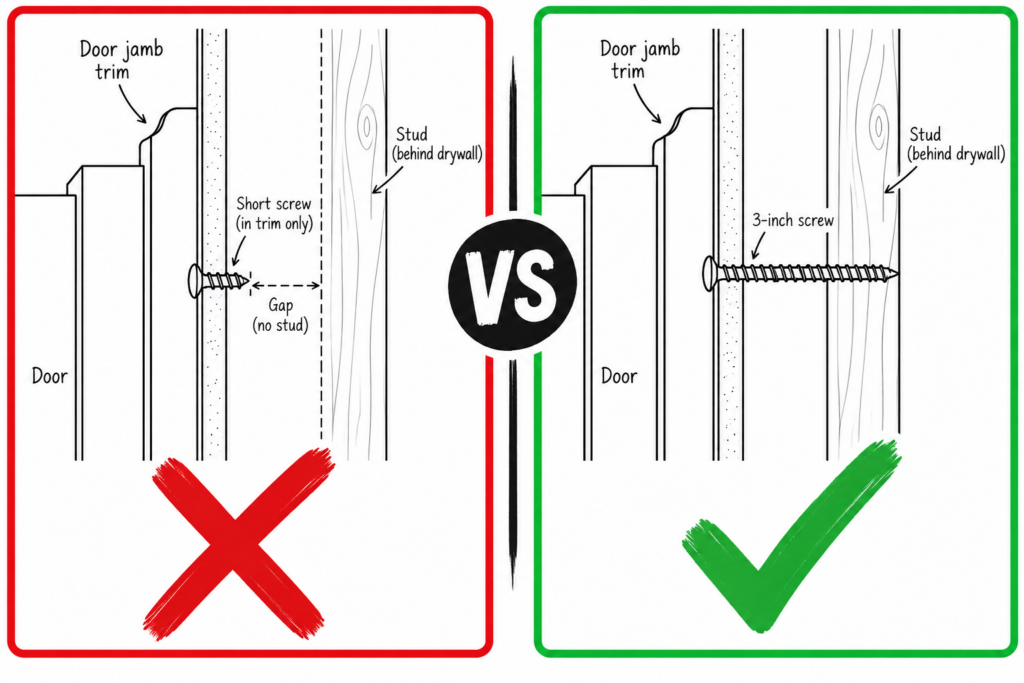
Any professional locksmith will tell you one of the easiest ways to boost your front door’s security is to swap the short screws in your strike plate for long 3″ ones. It sounds too simple to matter — but it’s one of the most common weak points I see on service calls, and it costs less than a cup of coffee to fix.
The Problem: Your Strike Plate Is Only as Strong as Its Screws
Most exterior doors ship with strike plates held on by 3/4″ to 1″ screws that bite into the door jamb’s trim — thin, soft pine that isn’t attached to your home’s actual framing. When someone kicks a door in, they’re not breaking the lock; they’re ripping the strike plate (and that sliver of trim) clean out of the frame. A fully engaged deadbolt won’t matter if the wood around it gives way.
The Fix: Screws Long Enough to Reach the Stud
Behind that thin trim sits the wall stud — solid, load-bearing framing lumber, usually 1.5–2 inches back from the doorframe’s face. A 3-inch screw passes through the trim and jamb and bites deep into that stud, anchoring your strike plate to the house’s structure instead of a piece of trim. Use at least 3 inches on standard strike plates and deadbolts; high-security setups use four or more screws that length instead of the usual two. It’s a small change with an outsized effect on how much force it takes to kick the door open.
What Screws to Actually Buy
- Length: 3″ minimum; 3.5–4″ for extra-thick jambs.
- Gauge: #8–#10 — thick enough to resist shearing without splitting the wood.
- Thread: Coarse-thread wood/deck screws grip stud lumber far better than fine-thread machine screws (those are for metal frames).
- Head: Flat-head Phillips or Torx/star-drive both work; Torx resists slipping under heavy torque.
- Material: Hardened steel, ideally with a corrosion-resistant coating (zinc-plated, satin nickel, or black oxide) for weather-exposed doors — it resists shearing far better than mild steel.
Rule of thumb: if the box just says “wood screws” with no mention of hardening or security use, it’s fine for hinges but not your best bet for the strike plate.
Real Examples Worth Knowing About
You don’t have to hunt down individual screws — several manufacturers sell standard size security deadbolt strikes and full reinforcement kits: reinforced strike plates (often 6–8″ long vs. the standard ~2.5″) paired with matching 3″ screws, standalone 3″ screw packs sized for strike plates, deadbolts, and hinges, and premium kits using six 3″ hardened screws across an extended plate for genuinely kick-resistant anchoring into the stud.
How to Do the Swap Yourself
- Remove the short screws from your strike plate — and your hinges, which share the same problem.
- If using a reinforced/extended plate, chisel out the mortise to fit its larger footprint.
- Drill a pilot hole slightly narrower than the screw shank to avoid splitting the wood.
- Drive the 3″ screws in at a slight inward angle so they bite the stud more securely.
- Test the door and deadbolt — minor misalignment afterward is common and an easy fix.
The Bottom Line
This is one of the highest-value, lowest-cost security upgrades a homeowner can make. Most people spend money on a fancier deadbolt while ignoring that a $3 pack of screws is often the real weak point. If you do one thing from this list today, make it this one.
This post may contain affiliate links. As an Amazon Associate, I earn from qualifying purchases at no additional cost to you.
Pingback:Smart Lock vs. Traditional Deadbolt - Which Is Safer? - Picked By A Pro
Pingback:Best Smart Locks for Home Security in 2026 - Picked By A Pro